
We track business and location closures across maps, directories, and registries: who left the market, where, and when. Clean dead contacts out of your CRM, analyze market dynamics, and find newly vacated locations.
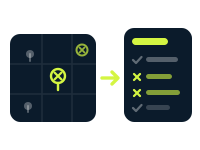
A closed location is a signal: for some, a dead contact in the CRM; for others, a vacated site or a shift in the competitive landscape.
Purge closed companies from your database: reps stop wasting time on dead contacts.
Vacated locations with proven foot traffic: candidates for your next site.
Closure trends by category and city: business survival rates and market saturation.
An early risk signal: a client closing locations is a reason to revisit limits.
Keep the customer base current: which locations still operate and which have closed.
Clean directories with no closed businesses: fewer user complaints.
Three formats to fit the task: a one-time export, recurring data delivery, or a custom solution. Exact pricing depends on your sources, volume, and frequency: you get a quote before we start.
Capture the data once: for research, migration, or analysis.
Data refreshes on a schedule you set (weekly to daily or hourly) and is delivered automatically.
Turnkey data as a service: API access, DaaS, or a ready-to-use interface, dozens of sources, and SLAs.
The total comes down to a few clear factors. No hidden fees: you get a quote and a data sample before work starts.
Describe the categories and regions, or send your database for verification — we'll get back to you with a cost estimate, timeline, and sample export within one business day.
Closure monitoring is the regular tracking of businesses and locations that have stopped operating: closed for good, moved, or changed hands. The system compares fresh snapshots of maps, directories, and registries against previous ones and flags vanished records, "permanently closed" labels, and other signs a business has shut down.
Every closure is verified across several sources: any single site can be wrong, so the status is cross-confirmed via maps, reviews, the website, and registries. Each record carries the name, category, address, the date the closure was recorded, and a flag: a single-location closure or a full company shutdown.
For sales teams, it's CRM hygiene: dead contacts stop wasting reps' time and skewing outreach stats. For analysts, it's market dynamics: where and in which categories businesses close, and how survival rates shift. For retail and franchises: vacated locations with proven foot traffic.
Monitoring runs on a schedule: weekly to monthly. You can also run a one-time check of your database: send a list of businesses and get it back with current statuses.
Brief case studies: how closure monitoring works for clients.
Drop lists from dozens of marketplaces merged into one stream with metrics, age and domain history.
A full registry of .co.uk blogs and news sites plus a ready-to-use HTML corpus in S3 storage.
Drug prices and availability from pharmacy sources consolidated into one comparable market picture.
An industry-wide database of online stores with verified contacts for the sales team.
We've been collecting data for sales and analytics since 2015, and we know closure data is only valuable when the status is verified, not lifted from a single site.
Every closure is checked across several sources: maps, reviews, the website, registries — never just one site.
We separate location closures, moves, and company shutdowns — statuses you can use without re-checking.
We record when a location closed and how long it operated — data fit for analytics.
We accept databases in any format and return the same structure with a current-status column.
A file, a refreshing feed, an API, or a web interface — data ready to load straight into your CRM.
A quote and data sample before we start, a contract, and clear pricing with no hidden fees.
A transparent process: we quote the project and send sample data before work starts. No hidden fees, no surprises.
Describe the categories and regions — or send your database for verification. A short description is enough.
A trial check on a segment, volume and timeline estimates, and a free data sample.
We cross-check statuses across sources and label closures, moves, and shutdowns.
File, feed, API, or interface — you pick the channel. For ongoing monitoring, we keep watch over quality.
The output: a verified list of closures with dates and flags, ready to load into your CRM or analytics.
Closed businesses with dates and flags — CSV, Excel, JSON, or XML.
Fresh closures arrive on schedule — your database stays current.
Business statuses straight into your CRM and systems — no manual exports.
A ready-made dashboard with a closure map, filters, and export.
Closure-type labeling, location history, and enrichment from registries.
We watch monitoring stability and status accuracy, and fix the scrapers when sites change.
Closure monitoring is part of a larger data collection system. We'll assemble and configure it around your task.
Ready-made business databases with contacts, built to your spec.
Monitoring of new openings: fresh leads with contact details.
Chain locations: newly opened and closed sites.
Business reviews and ratings for reputation control.
Can't find the answer you need? Send a request — we reply within one business day.
We combine several signals: "permanently closed" labels on maps, vanished listings, reviews going stale, an unreachable website, and statuses in official business registries. Closures are cross-confirmed — we never draw conclusions from a single site.
Base pricing starts at $150. The final price depends on the number of sources, data volume, update frequency, protection complexity, and extra processing. We provide an exact quote and a data sample before work starts.
Yes, it's a standard task: send a file with your businesses, and we return the same structure with status columns (operating, closed, moved) and the date each status was recorded.
Yes: we compare business details, phone numbers, and names across areas — if the business reappears at a new address, we label it a move, not a closure. Company shutdowns are checked against official sources, such as Companies House or state registries.
A file (CSV, Excel, JSON, XML), a refreshing feed, API access, or a ready-made web interface with a map and filters. Format and field structure are matched to your CRM.